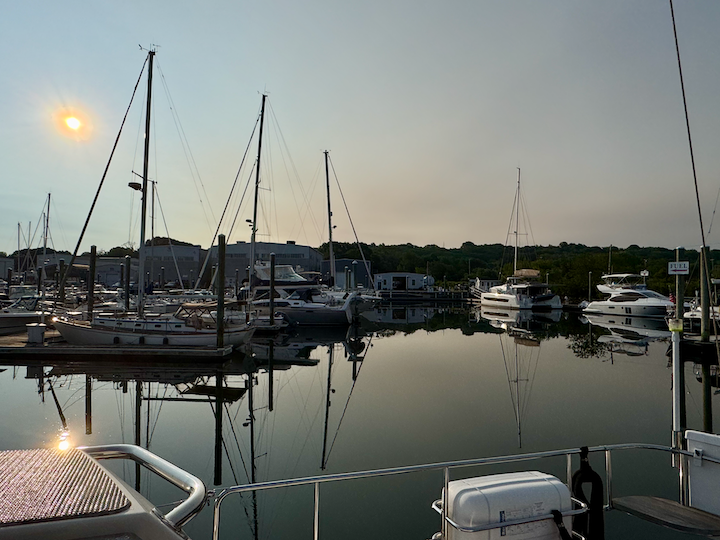
After a night in Newport, we pushed a short 10 miles up the Narraganset Bay to Portsmouth, RI. We booked a dock at New England Boatworks, a marina surrounded by service companies covering all aspects of boats: mechanics, electricians, plumbers, and plenty of other expertise.
It was a calm, downwind sail, which was a nice change from some of the rougher stuff we’d encountered on the open ocean. In contrast to the busy harbor at Newport, we had most of the bay to ourselves, other than an occasional fishing boat.
We stopped at the fuel dock to top off our our 170 gallon diesel tank. With the prevalence of wind this year, that could well take us through the end of the season.
Often, the workers at marinas are local high school and college students working for the summer. These kids were no exception, and several of them were headed off to college in the Fall. We offered up our unused dorm fridge, which they gladly accepted. Within the hour, they had it running in their fuel office to keep drinks and lunches cold!
Docking is quite different than mooring or anchoring. It takes more work, setting up docking lines and fenders, figuring out the marina layout, figuring out the docking setup: bow-in or stern-in, port or starboard side tie-up, wind, current, etc. In much of the world, marinas use Mediterranean mooring to save space. This is where there are no finger docks to tie up to between boats. The stern is tied to the dock, and the bow is held off the dock with lines permanently anchored to the ocean floor. In N. Amerca, where space is less of a problem, most marinas have finger docks, allowing for much easier docking alongside. Nonetheless, it can be tricky depending on manoevering space, currents, or cross winds.
Fregata is a big heavy beast, weighing in at just over 20 tons, so you can’t just stop her on a dime, or make quick turns. Therefore, docking is done in slow motion… just enough speed to keep water flowing over the rudder. Too slow, and there’s insufficient water flow to make steerage possible. I always prefer port side tie-up because our helm is closer to that side of the boat. Also, when the propeller is put into reverse to bring her to a final stop, it tends to kick the stern to port (“prop walk”), which helps bring the boat parallel to the dock.
They say (tongue in cheek) that sailing is 90% boredom and 10% panic. Docking often falls into the latter category! And another applicable rule is that the more people are watching you manoever, the more likely you are to screw up!
Anyway, we’ve gotten pretty good at it. Sandy handles the lines and fenders. We talk to each other via two-way headsets as it’s often hard to hear from one end of the boat to the other. Sometime, there’s assistance ashore whom she directs. Often, people on shore want to tell us what to do. We politely ignore them, as we can’t rely on their knowlege.
Deciding the sequence of lines ashore is critical. The first line tied-up is often used to stop the boat and help swing it in one direction or the other. People on shore don’t know the plan. And remember, they’re usually high school students, not experienced mariners.
After living on anchors or moorings for days at a time, docking seems like a real luxury (and the price for docks these days confirms that!). First of all, there’s ample supply of electricity, fuel, and water, commodities requiring careful management when offshore. Secondly, getting to a nearby town, supermarket, or nail spa (wonder who) doesn’t require using the dinghy… you can just walk or Uber. It’s a nice place to meet other boaters. Finally, there are often amenities like laundry, showers, pools, convenience stores, restaurants, and loaner cars. One marina in Canada even has a self-service herb garden.
We had booked technicians for some minor electrical problems, and to work on the freezer. The electrical problems are resolved. The refrigeration tech found one leak in the freezer’s regfrigerant circuit, but it still failed the pressure test, so he’ll continue troubleshooting this morning.
Next, back to Newport to rendezvous with the Salty Dawgs, with whom we’ll sail in flotilla back to Maine.the
9 Responses
Your summer sounds wonderful. Glad the repairs to the refrigerator were relatively minor and the electronics issues were easily diagnosed. I’m doing a Salty Dawgs trip later this year as we head from North Carolina to Antigua on John Geissinger’s boat. Hope you have fun.
That should be a great trip, Larry. And thankd from Sandy for the birthday wishes.
Oh, and Happy Birthday Sandy!!!
Dan, are you going to send us a photo of your newly done nails from the nail spa?
The Freedom Yachts factory was originally in Warren, RI and subsequently moved to Portsmouth.
Happy sailing.
I’m more into pedicures (NOT), Jim! LOL
Sounds like your life abroad Fregata is just like our house, something always needs to be fixed.
Just like home!
Yes, but your house doesn’t live in salt, damp conditions!
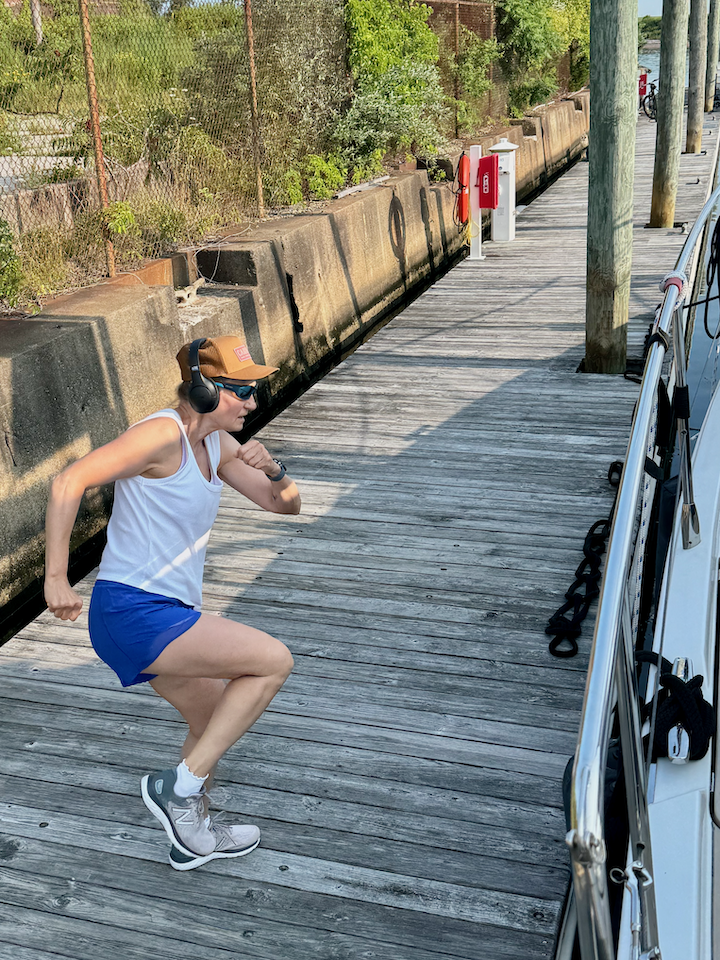
Hey Sandy and Dan, as always very interesting details on your docking scenario. Fortunately, our boat is much smaller and lighter, and even though we only have about a foot between ourselves and our neighbor in our finger, like your preference , we are able to dock on the port side which definitely makes life and docking easier! We agree, sometimes it’s easier to do it yourself, but never turned down the offer of assistance. Great action shot Sandy! Amazed that Dan can dock the boat and take pictures of you at the same time.😜
Ha! That would mean she jumped off and started doing a workout before we even tied up. We’re not THAT good at docking.