No two days are exactly alike. There are “stay” days and “go” days. On “stay” days, you don’t travel, but rather hang out in a port or anchorage, sightseeing, hiking, or taking care of maintenance, laundry, boat cleaning, etc. The following is an example of a “go” day when we’re atually sailing from place to place.
The day really starts the night before when we look at nautical charts, tide charts and weather reports to plan the passage. The goal is to try to get the stars to align between :
- Safe weather
- Favorable winds
- Favorable tides & currents
- Timing for daylight arrival
- Working around other commitments, such as business teleconferences
Of course, it’s not always possible to align all of these, but we try to cover as many as possible. The only non-negotiable one is safe weather. Forecasts aren’t perfect and one always has to hope for the best while planning for the wost, but forecast models have come a long way in their accuracy. We usually check multiple sources. Unless there’s a requirement to travel, we avoid winds over 25 knots, waves over 4 feet, thunderstorms, and similar.
Next, we plot a course. This used to be done with paper charts and special plotting tools. Now, with GPS and sophisticated software and electronics, we do computer-aided plotting. We use an iPad with a chartplotter application called Navionics Boating. Based on the characteristics of the boat, it automatically traces an optimized route. Some sailors use more sophistated tools such as PredictWind that take into account wind to further optimize the course. Although these apps are supposed to avoid shallow water and other hazards, we never completely trust them, so we manually review and revise the plot waypoint by waypoint to make sure we agree. We then upload the plot to Fregata’s main chartplotter using GPX, a standard format for sharing navigational data. We continue to use both the main plotter and the iPad for redundancy in case one fails.
The day before also includes checking fuel, water, and battery charge. In the engine room, we check the oil and clean the raw water strainer. Diesel engines are cooled by exchanging engine coolant heat with cold, circulating seawater. The seawater passes through a strainer to catch seaweed or other debris, and can get clogged.
If we’ve been using the dinghy, we hoist it onto the davits and secure it for travel.
We take a general look around to make sure everything else looks copacetic.
The morning of, we’re usually up at first light. For longer passages, we sometimes depart well before dawn. It’s easier to exit a known anchorage or port in the dark, than it is to arrive at an unknown one.
After a strong shot of coffee, we do a final weather check. We secure the cabin, locking cabinet doors and drawers, putting away anything loose, and closing hatches. We turn on the navigation equipment, which includes the chart plotter, VHF radio, wind and depth instruments, radar, and autopilot. We start the engine, and put on two-way headsets. To leave a mooring, dock, or anchorage, one person drives the boat from the helm, while the other positions himself or herself on the deck. It’s very hard to hear each other, so we use headsets to avoid shouting. Some cruising couples call them, “marriage savers”. The departure procedure takes careful coordination and it’s different depending if you’re anchored, on a mooring, or tied up to a dock.
Leaving an anchorage can be tricky. Because of shifting tidal currents or wind, the boat will have moved around and the anchor chain may not lie in a straight line between the boat and the anchor. To avoid straining the windlass, the crew at the bow observes the direction of the chain as it comes up and instructs the crew at the helm to go forward or in reverse, attempting to keep the chain directly below the bow, and slack. The crew at the bow progressively raises the anchor using a remote controlled windlass (a winch-like device specialized for anchor chain). There’s a spraydown pump at the bow that is used to wash mud off of the chain and anchor as they come up. Once the anchor is safely on board, the crew gives the “all clear” so that the helmsperson can drive away and start following the course.
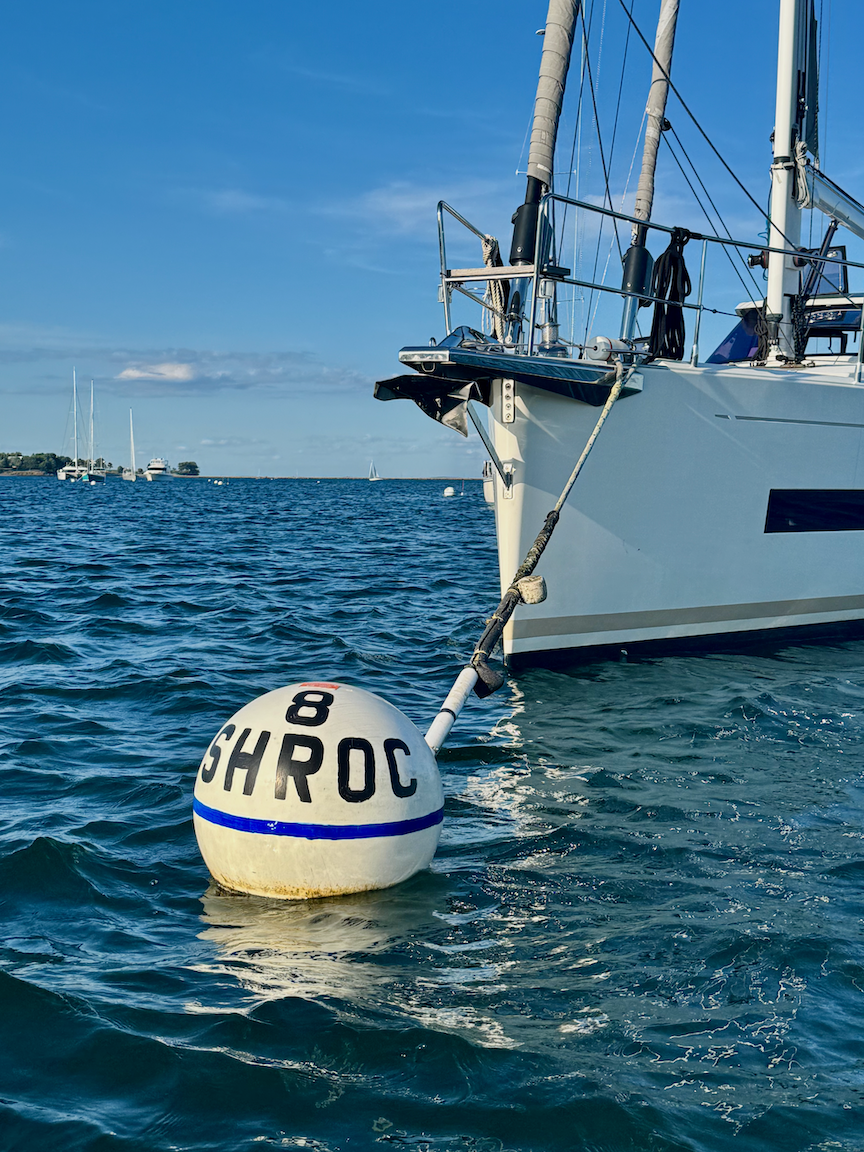
Leaving a mooring is simple. It’s just a matter of taking the pennant (rope connecting the boat to the mooring chain) off of the bow cleat and dropping it in the water.
Leaving a dock can be simple on still days, but if the wind is blowing hard, it takes careful planning in terms of which lines can be untied first. The most critical lines are untied last. In the case of a leeward (downwind) dock, a spring line is used in concert with the engine and bow thruster to point the boat away from the dock before untying the last line. Each circumstance requires a specific plan, considering wind, maneuvering space, etc.
There’s often help available but that can be a double-edged sword. On one hand, it’s nice to have someone on land assist with releasing lines. On the other hand, some “help” is comes from passers-by with no experiene, or from know-it-alls that want to do it their way, foiling the carefully planned maneuver. We have to balance being forceful and give orders, while remaining polite and expressing gratitude. Now THAT’s hard!.
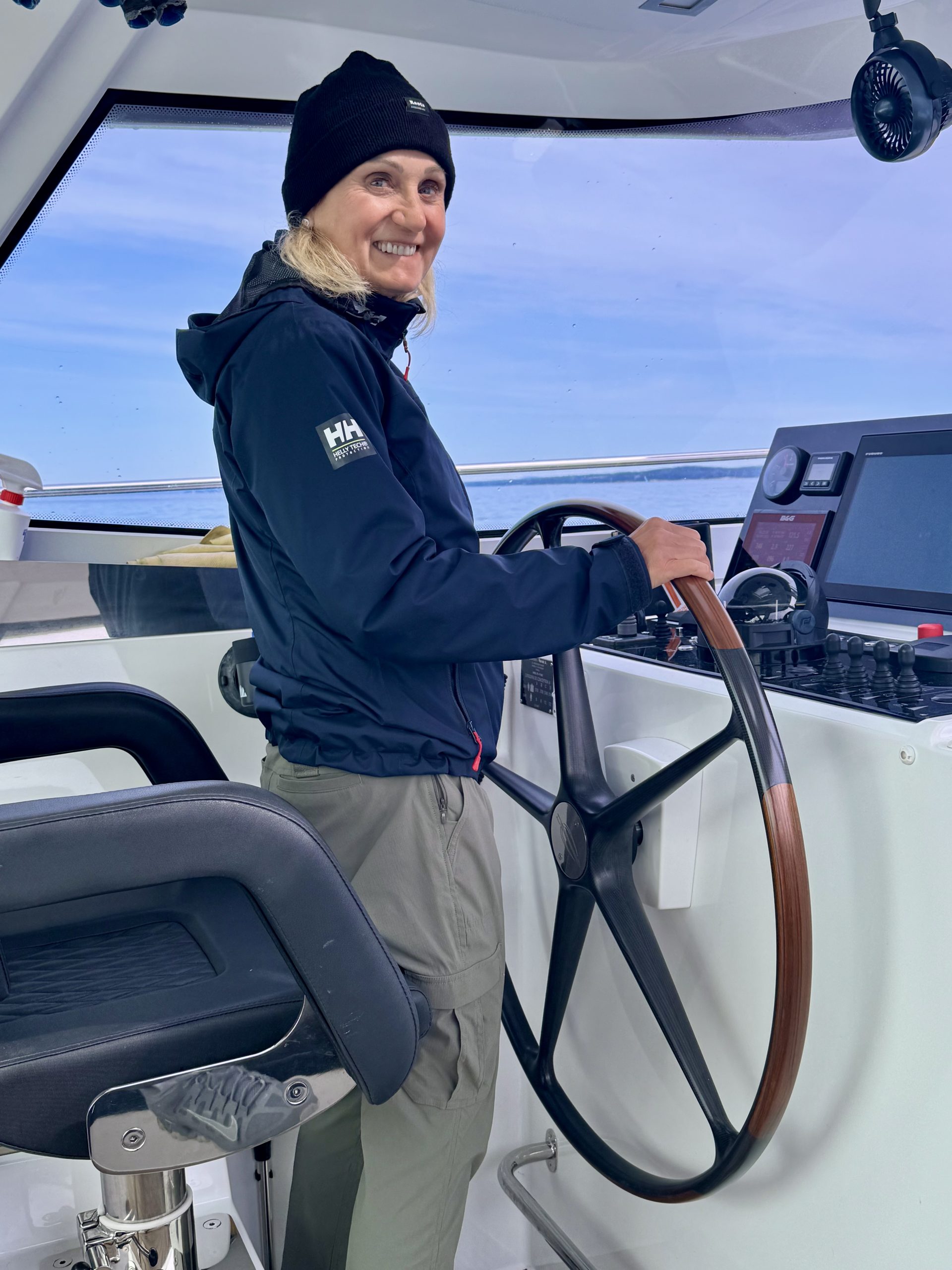
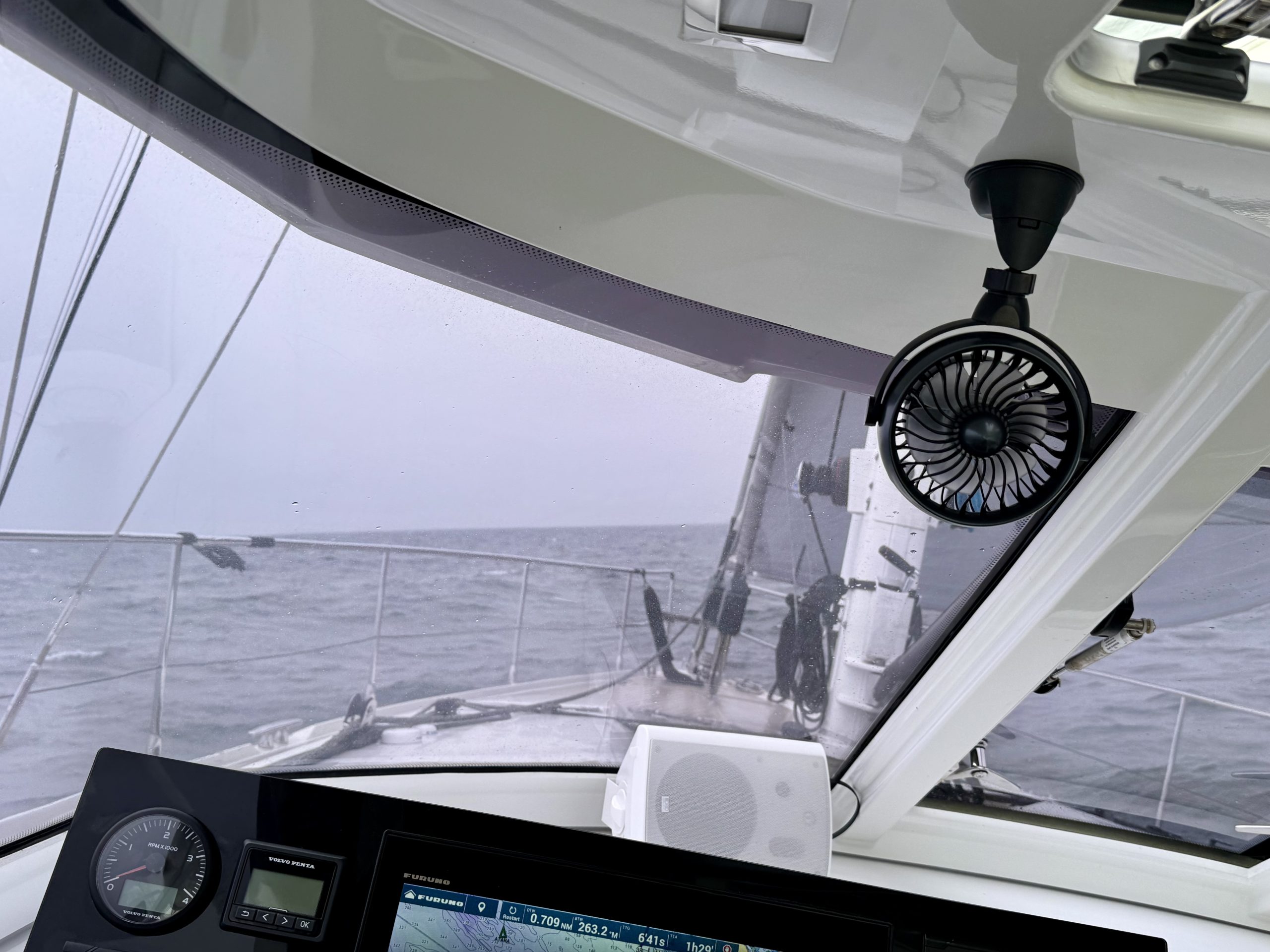
Once we’re underway, we adopt a 2-hour watch (shift) schedule. During a watch, the designated skipper drives the boat, keeping it on course, and is responsible for keeping an eye out for other vessels or hazards. The skipper also maintains radio watch, listening to the VHF radio for important information, and responding to calls specifically to our vessel. The skipper can also initiate calls to other approaching vessels to agree on how to pass each other without a collision. When it’s foggy, the skipper also watches the radar for other vessels or obstructions. The off-duty crewmember remains available to assist with maneuvers under the skipper’s command, but otherwise is free to rest, read, work, etc. Whoever is not on watch also takes care of preparing coffee and meals.
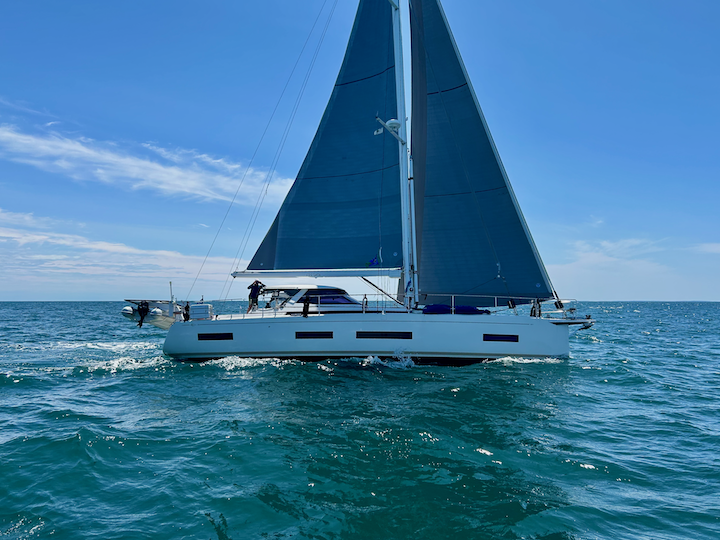
They say sailing is 90% “boredom” and 10% “panic”. This refers to the fact that most of the active work happens for brief moments during departure, arrival, or maneuvers. In between, there’s often not much to do. When the weather is stable and the wind is constant, we can pretty much leave the sails alone (“set ’em and forget ’em”), and delegate steering to the autopilot. There are exceptions to this, such as sailing upwind, with constant tacking maneuvers. The main activity of the skipper is to keep the boat on course and to keep the vessel and crew safe. In Maine, it also includes avoiding lobster traps!
Even during those conditions when the boat mostly sails itself, the skipper must stay constanty vigilant. It only takes the time of reading a text message to sneak up on a lobster trap, or for another vessel to appear.
Before arrival, there is work to be done. An arrival plan is made, again depending if its an anchorage, mooring or dock.
When anchoring, again, a crew member is stationed at the bow to deploy the anchor. The helmsperson drives the boat slowly in reverse to make sure the anchor chain lays nicely. Once enough chain is deployed, we test it by marking the spot on the chart plotter, and driving harder in reverse to make we stay in the same place. We set an anchor alert, which is a simple smartphone application that alerts you to dragging the anchor or moving more than a maximum allowed distance. We also set a “snubber”. This is a piece of line attached to the anchor chain several feet below the surface, and to the bow cleats on the boat. It is taught, while the anchor chain is slack, taking the pressure off of the windlass, and providing for more catenary (sag) in the chain, which helps the anchor lay flatter and thus hold better.
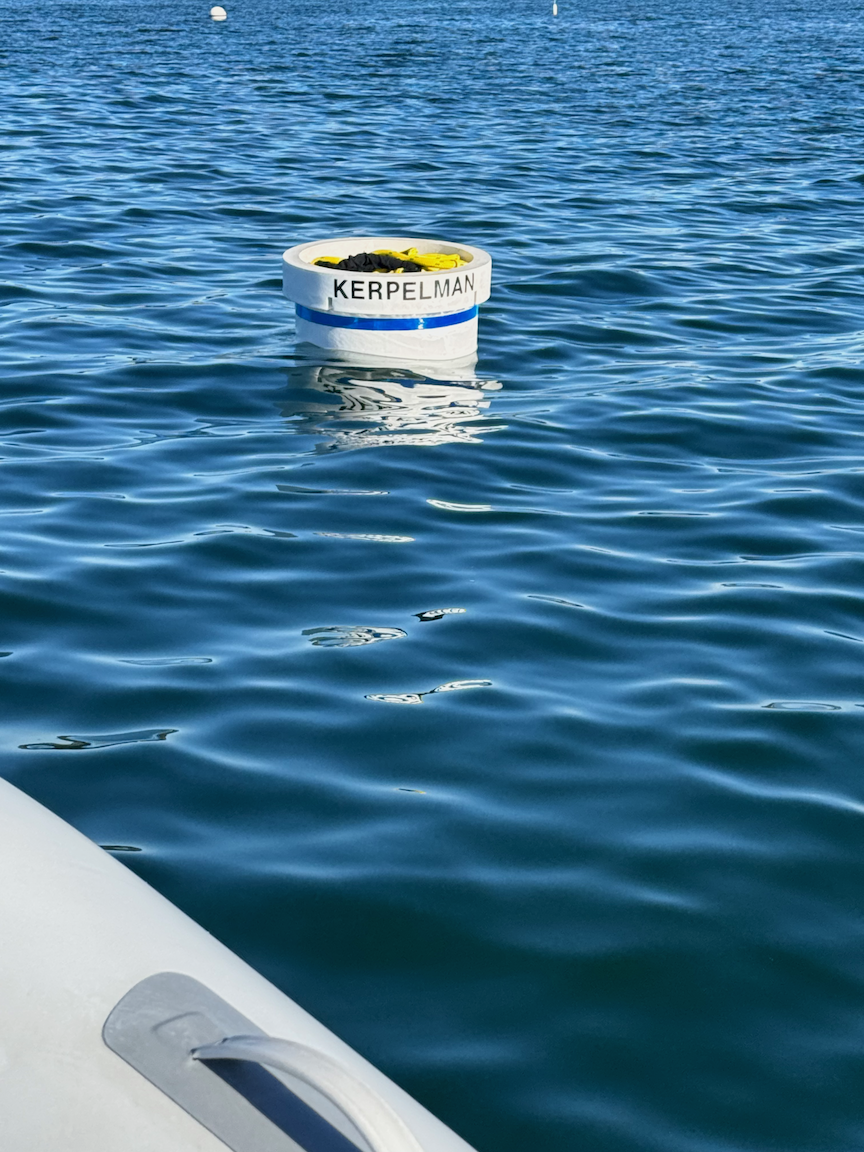
Mooring requires driving the boat slowly toward the mooring, and having a crew member pick up the pennant with a boat hook. This requires a careful balancing act. A boat can’t steer when it’s going too slowly, but it needs to come to a full stop when alongside the mooring ball. Also, it’s impossible to see the mooring gear from the helm when close to it so, again, crew to helm communication is critical.
Docking is the most complex. First, it requires inflating and deploying fenders on the side of the boat. It requires setting up docking lines for the particular situation: alongside, bow in, stern in, or Mediterranean mooring (more common in Europe). As with departure, a plan is made as to the sequence of lines taken ashore. And, as with departure, help onshore, although welcome, needs to be managed with a blend of forceful instructions, and gentle gratefulness. Often dockhands are students working for the summer. They appreciate a tip so we keep a reserve of small bills onboard for that purpose.
Once secure, we enter arrival information in the ship’s log, turn off the instruments and engine, put away life jackets. If we’re at anchor or on a mooring, and plan to go ashore, we deploy the dinghy.
That’s it in a nutshell. In the evening, we make dinner, relax with a book or a movie, and start all over again!
Then there are the atypical days, but that’s the subject of another post.

8 Responses
Extremely instructional and always nice to hear about a typical day of sailing, docking/mooring/anchoring from an experience, captain😘
Hi Donna, As you and Jim know, although we’d like them to be, typical days aren’t that typical!
Dear Dan and Sandy I am exhausted just reading about your typical day.
Keep up the blogs what fun we are having to be along for the journey
Sorry to tire you out, Pete and Carol 🙂
These updates are fascinating. Never knew all the factors involved in sailing. So interesting
My only sailing experience was on an aircraft carrier where the non-com Marines were stuffed.
Bet it didn’t have sails!
wow – detailed and insightful! Love virtually coming aboard. stay safe👍.
Thank you!