Moorings are like permanant anchors that stay in the water rather than come with the boat. They come in different shapes and sizes. Here’s a typical local configuration, bottom-up.
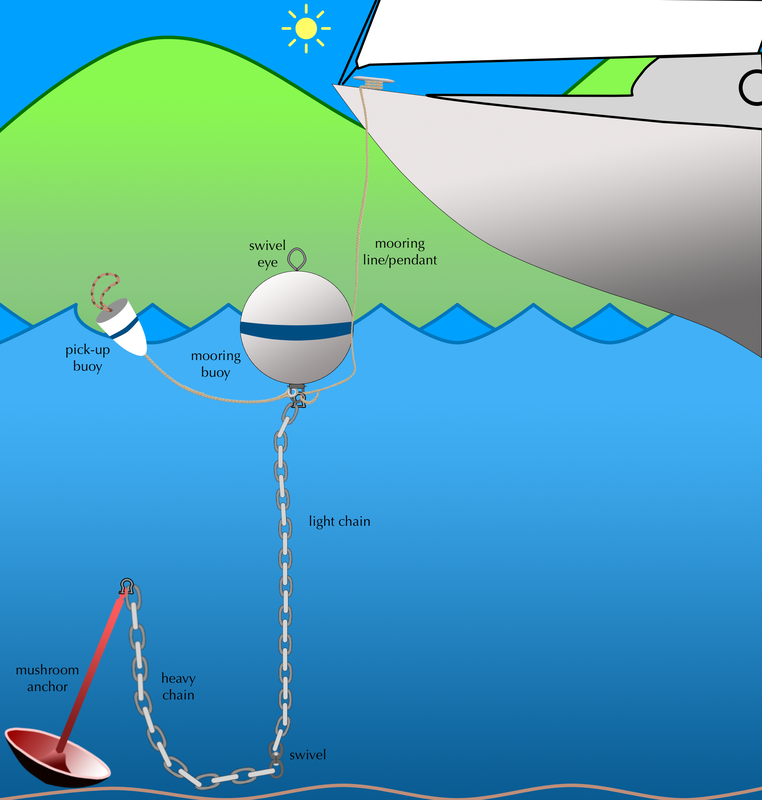
On the ocean floor is a mushroom anchor, a heavy metal anchor shaped like an upside-down mushroom. Our home mooring weights 1,200 lbs (545 kg). Next comes a length of heavy chain, 15 ft (5 m) in our case, called navy chain. This chain lays on the ocean floor providing additional weight, and causing the mushroom anchor to lie down so its flanges can dig into the mud better. It also works as a shock absorber. If a strong wind or current blows the boat away from the mooring, the heavy chain lifts and lowers smoothly, rather than the boat tugging directly on the mushroom anchor.
In other regions without good mud, heavy blocks of cement are used in lieu of mushroom anchors. Another variant is a an auger that’s screwed into rock.
Next comes a length of light chain, roughly the length of the highest expected tides, connecting the buoy to the heavy chain via a swivel.
The buoy itself is a floating ball with hardware to attach it to the light chain and to the pendant (line between the buoy and the boat). Our buoy is called a “bird’s nest” because there’s a recessed area on the top into which the pendant can be placed when away. This keeps it dry and avoids accumulating algae and marine animals.
The pendant is the line that is picked up and attached to a bow cleat of the boat. It’s a length of heavy rope with an eye splice at the boat end. Sometimes it splits into two ends so that it forms a Y-shaped bridle attached to both bow cleats. It is usually surrounded by floats to keep it on the surface. This facilitates picking it up, and keeps it from fouling the propeller should it find its way under the boat.
Optionally, there is a smaller line connecting the end of the pendant to a pickup float with a long vertical stick called a pickup stick. It makes it easier to pick up the pendant. Rather than reach overboard with a boat hook, a crewmember can stand comfortably on the deck and pull up the stick. Note that in the illustration above, the pickup float is attached to the mooring ball. Normally, it’s attached to the pendant. Also, this illustration does not include a pickup stick.
In Falmouth, where our home mooring is, there are approximately 1,200 moorings! The mooring field is governed by town ordinances, a board and a full-time harbormaster belonging to the police department.

An annual permit must be obtained for a modest fee. It assigns a unique number to the mooring.There are several service companies that help select and source the mooring gear, set it up initially, and maintain it. This includes hauling it out each Fall, storing it over the winter, and redeploying it each Spring. Only the buoy and penants are removed. A smaller float is attached to the light chain to keep it at the surface, and to mark the spot for the following season. The service also includes performing an obligatory inspection of the entire setup every two years.

Aerial view of the Falmouth mooring field. Can you count them?
6 Responses
Very detailed and interesting. What a process, so in addition to watching for lobster traps you’re watching for moorings!
They are pretty thick in places. In fact, there are supposed anchorages that are so full of moorings that there’s no swing room. Some towns regulate better than others.
PS. So not only do the Kerpelman’s have a number on their mooring, they have it personalized.😜
I think it’s required by the town harbor authority, but kind of cool to have your name on the ocean I guess.
Im impressed that they put your name on it. Here in Chicago, we simply get a number assignment and they remove everything at the end of the season. Very interesting explanation. 1,200 moorings? Wow!
We get a name and a number.